 Daytiles
How to start running
You don't have to be able to run for 30 minutes to start running. You start by running for one minute, walking, and doing it again. Here's a plan that gets beginners to 5K.
The short version
- Mix running and walking. Start with one minute of each.
- Run three times a week with a rest day in between.
- Go slow enough that you could talk.
- Get shoes that fit and support your feet, and see a doctor first if you have a heart condition.
Daytiles keeps track of it for you, free on iPhone, iPad and Apple Watch. Get it on the App Store.
Start with run-walk intervals
Most new runners go out too fast, run until they can't, and decide running isn't for them. Mixing short runs with walking lets your heart, lungs, legs and joints catch up, and it means every run is one you can finish.
Start with one minute of easy running, then a minute or two of brisk walking, repeated for 20 to 30 minutes, with a few minutes of walking to warm up first. Each week, run a little longer and walk a little less. The NHS plan below has you running for 30 minutes without stopping by the end.
Go slowly. If you can't say a sentence while you run, you're going too fast. Slow is how you build up to longer runs, and it's how you avoid getting hurt.
Follow a plan: Couch to 5K
If you'd like someone else to do the planning, the NHS has a free plan called Couch to 5K. It takes you from no running to running 5K, about three miles, in around nine weeks, and you can take longer if you need to.
- You run three times a week, with rest days in between.
- Week one alternates one minute of running with a minute and a half of walking, at a pace that suits you.
- The free NHS Couch to 5K app, on the App Store and Google Play, talks you through each run, and you can play your own music under it.
Repeat a week if it felt too hard. Nobody's timing you, and taking 12 weeks instead of 9 still gets you there.
Running three times a week for half an hour also gets you most of the way to the CDC's advice for adults: 150 minutes a week of moderate activity, or 75 minutes of vigorous activity.
Get shoes that fit
You don't need much to start running, but shoes matter. The NHS suggests comfortable clothes and running shoes that support your feet, plus a supportive sports bra if you need one.
- Buy for comfort and fit, not looks. Your toes shouldn't hit the front, and your heel shouldn't slip.
- Try them on with the socks you'll run in, and jog a few steps in the shop if you can.
Rest days are part of the plan
Your body adapts to running in the days between runs. Running every day as a beginner gives it no time to recover, and sore legs can force a longer break. Keep a rest day between runs.
- On rest days, walk, stretch or do something gentle if you like.
- Some aching the day after is normal. Sharp pain, or pain that gets worse as you run, isn't. Stop, rest, and get it looked at if it doesn't settle.
- Missed a run? Do the next one. You don't need to make it up.
Make it easy to go
- Pick your days and times. Monday, Wednesday and Saturday mornings, say. Plans that say when you'll go get done more often than "sometime this week".
- Lay out your kit the night before. Shoes by the door, clothes on the chair.
- Run with someone. A friend, or a free local group like parkrun, makes it much harder to skip.
- Count runs, not speed. For the first couple of months, the only thing that matters is that you went.
If you have a heart condition, chest pain, high blood pressure, diabetes, joint problems, or haven't been active for a long time, talk to your doctor before you start. The NHS also says to see a GP first if you're worried about your health.
Set it up in Daytiles
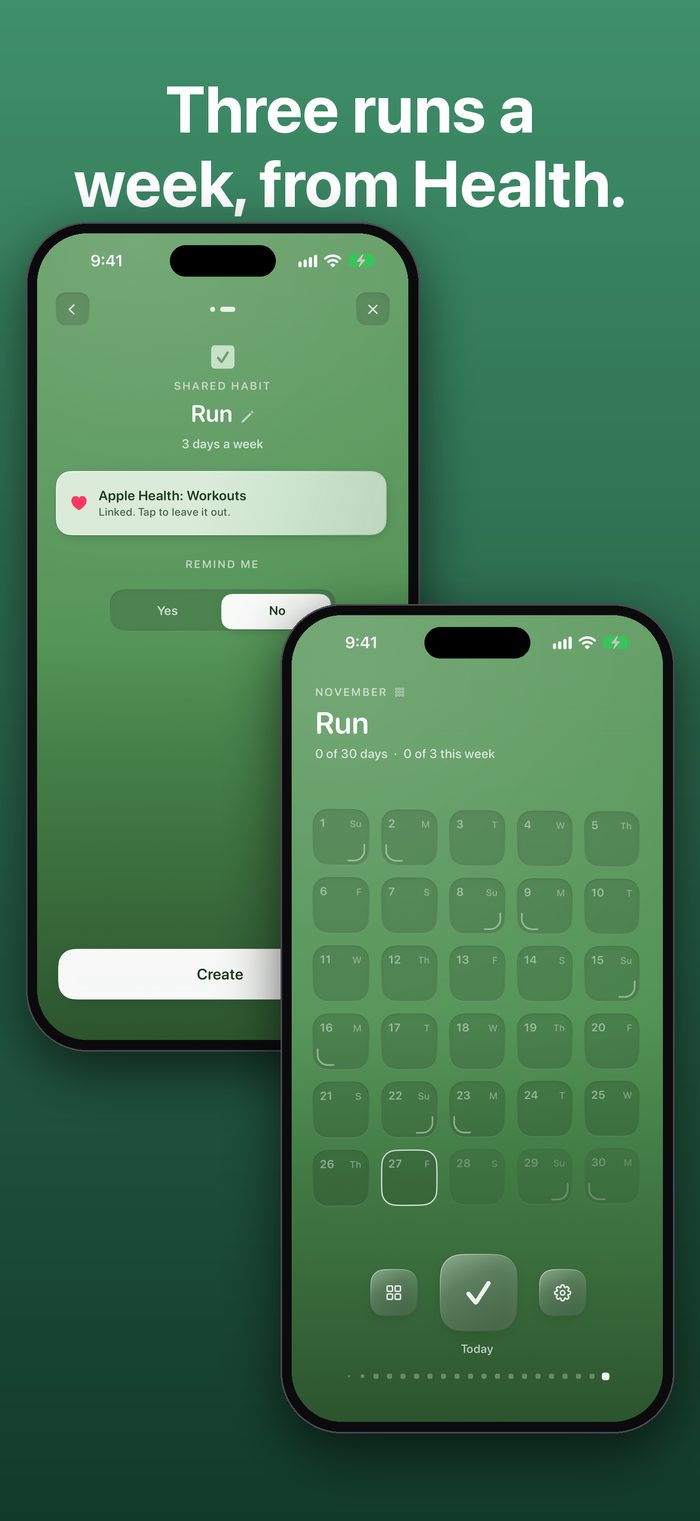
Make a Run habit for three days a week, any days. Linked to Apple Health, a run you record on Apple Watch or in another running app checks the day off by itself.
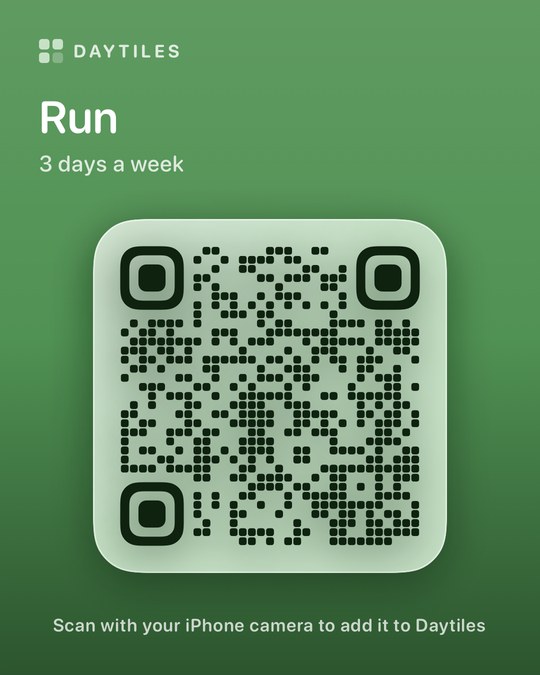
The quickest way is the code on this page. Scan it with your iPhone camera, or tap it on your iPhone, and Daytiles opens with the habit set up, ready to add.
- Tap + on home to make a new habit, then tap Make your own.
- For "What do you want to do?", type Run.
- For "What's the goal?", choose Once per day.
- For "Which days?", choose Some days a week, then tap 3.
- On the same screen, tap Apple Health: Workouts to turn it on Pro.
- Pick a color you like.
- When it asks about reminders, tap No. You can add one later in the habit's settings.
- Tap Create.
It asks for any three days a week. Once you've run three times, the week's goal is met, and the rest days left that week don't count against it.
- Runs check themselves off Pro. Record a run on your Apple Watch, or in Couch to 5K or another app that saves workouts to Apple Health, and the day checks itself off. Any workout counts, so a ride or a walk you record will too.
- Or check it off yourself. Tap the button under the month. Daytiles writes a 30-minute workout to Health for it.
- Earlier runs. Linking counts from today on. There's a button in the habit's settings to bring in earlier days.
- Fixed days? Tap the gear and change the schedule to Set days, like Monday, Wednesday and Saturday. Days off the schedule never count against you.
- A nudge to go at your running time Pro. Without Pro, your morning or evening reminder from Settings can include it. It won't come on a day you've already run.
- Hurt or ill? Touch and hold today's button to skip today, or in Settings tap Pause. Skipped and paused days don't break your streak.
- Celebrations. Meeting your three for the week gets a moment of its own.
Daytiles is free for up to three habits, and Pro makes room for as many as you like.
Sources
Updated November 3, 2026. Daytiles is made by Jason, one person. Tell me if something here is wrong.