 Daytiles
How to stop drinking alcohol
Whether you want to stop for good, take a month off or stop the glass of wine every night, the same few things help. Start with the one that keeps you safe.
The short version
- If you drink heavily every day, talk to a doctor before you stop. Sudden withdrawal can be dangerous.
- Free, confidential help is a call away: SAMHSA's helpline, 1-800-662-4357, any time.
- Change the evening routine that the drink belongs to, and keep less of it at home.
- Count your days without a drink. A slip doesn't erase them.
Daytiles keeps track of it for you, free on iPhone, iPad and Apple Watch. Get it on the App Store.
First, stop safely
If you drink a lot every day, or you get shaky, sweaty, anxious or sick when you go without, your body has come to depend on alcohol. Stopping all at once can bring on withdrawal, and severe withdrawal can cause seizures and can be life-threatening. That doesn't mean you can't stop. It means you should do it with a doctor, who can help you stop safely, sometimes with medicine for the first few days.
If you drink heavily every day, talk to a doctor before you stop suddenly. If you have a seizure, see or hear things that aren't there, or become confused while cutting down, get emergency help right away.
If you drink a few times a week and never feel unwell without it, you can usually just start. If you're not sure which group you're in, ask your doctor. It's a common question and they won't judge you for it.
Get help, it's free
- SAMHSA's National Helpline. In the US, call 1-800-662-4357. It's free, confidential and open 24 hours a day, every day of the year. They can point you to treatment, support groups and local services. You can also search for treatment near you at findtreatment.gov.
- Rethinking Drinking. The National Institute on Alcohol Abuse and Alcoholism runs Rethinking Drinking, a free site that helps you look at your own drinking, work out what a standard drink really is, and make a plan to cut down or stop.
- Medicine. There are medicines that help people drink less or stay stopped, like naltrexone and acamprosate. Many people never hear about them. Ask your doctor whether one is right for you.
- Support groups. Alcoholics Anonymous and SMART Recovery both run free meetings, in person and online. They work differently, so if one doesn't suit you, try the other. Sitting with people who get it helps a lot of people.
Outside the US, your health service has its own help. In the UK, the NHS site lists alcohol support services.
Stop or cut back?
Both are real goals. Some people do best stopping completely, because one drink makes the next one easier. Others want to drink less, not never. Be honest with yourself about which one works for you. If you've tried cutting back a few times and it keeps sliding, stopping may be simpler.
If you're cutting back, make the rules clear before the evening starts, when you're thinking straight:
- Pick your drink-free days in advance, for example Monday to Thursday.
- Decide how many you'll have, and count them. A standard drink in the US is about 12 ounces of regular beer, 5 ounces of wine or 1.5 ounces of spirits. A big pour of wine can be two.
- Have water or something else between drinks, and eat first.
The wine every night
For a lot of people the drink is part of a routine: home from work, open the bottle, pour a glass while cooking. That's a habit, and habits are tied to cues. Change the cue and the pull gets weaker.
- Don't keep it in the house. If it's not there, you have to decide to go out and buy it, and that's a much bigger step than opening the fridge.
- Replace the ritual, not just the drink. Keep the nice glass and fill it with something else: sparkling water with lime, a non-alcoholic beer or wine, iced tea.
- Move the evening around. Go for a walk when you get home, cook something new, call someone. The first few evenings feel strange, then they become normal.
- Notice what the drink was doing. If it was how you relaxed or how you got to sleep, you need another way to do that. Otherwise stress and poor sleep can pull you back to it.
- Tell the people you live with. It's much easier when nobody pours you one by default.
Get through cravings
A craving rises, peaks and fades if you wait it out, usually sooner than it feels like it will. You don't have to fight it, just wait it out. Delay, drink something else, eat something, get out of the room, or text someone. Have a plan for the hard moments you can see coming: Friday night, a wedding, a bad day. Having a reply ready ("I'm not drinking right now") makes social events much easier.
Count your days without alcohol
Counting sober days works for the same reason it works for smoking: each day is a small win you can see, and a growing run is something you'll want to protect. It also shows you how far you've come on the days that feel hard. Keep a note of what changes along the way, like sleep, mornings and money, and look back at it on those days.
If you slip
A drink after a run of sober days doesn't wipe out those days. Work out what led to it, change that, and start again the next day rather than next month. If you keep slipping, get more help: a doctor, medicine or a group. Lots of people need more than one try and more than one kind of help.
Set it up in Daytiles
Daytiles has a ready-made No alcohol habit, a sober day counter that counts your days without a drink for you. There's nothing to check off. Every day counts as clean until you log a slip.
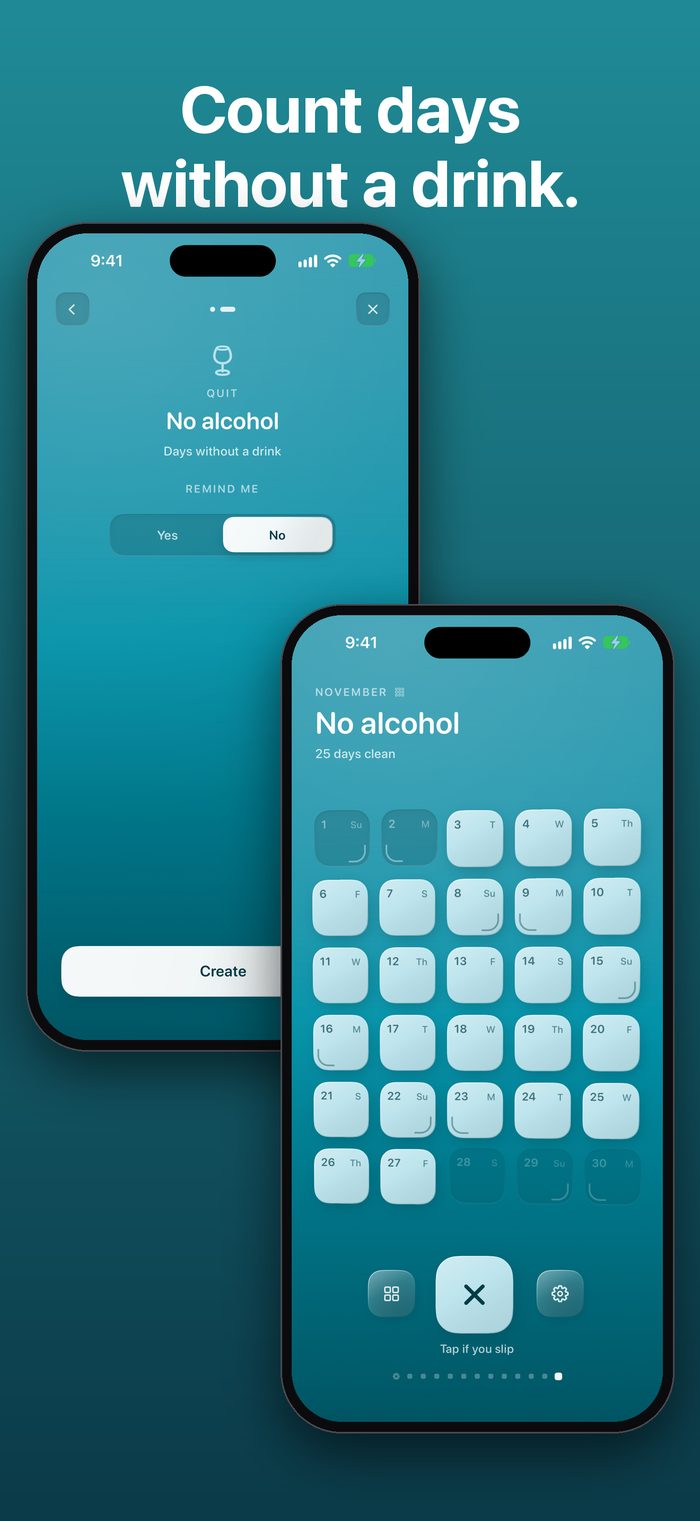
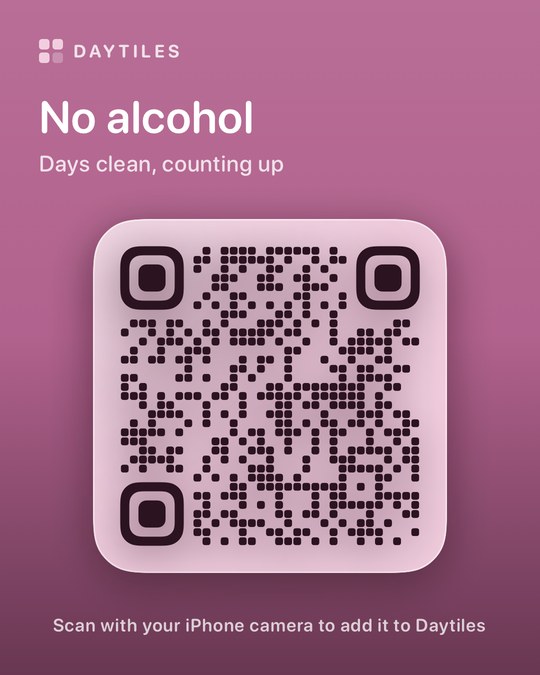
- Tap + on home to make a new habit.
- Under Quit, tap No alcohol. It says "Days without a drink".
- Look it over and tap Create. You can leave reminders off: quit habits don't send any.
Its page shows how many days clean you are, and each day without a drink lights a tile.
- If you slip, tap the button under the month (it says "Tap if you slip"), or tap the day it happened. The count starts over the next day. Tap it again to take the slip back if you tapped by mistake.
- Your record stays. Pinch in on the month to see your year: days clean, the share of days clean, and your longest clean run. A slip doesn't take those away.
- Milestones get a moment. A week, two weeks, three weeks, 30 days, 50 days and every 50 after that each get a celebration, and so does a whole month clean.
- Cutting back instead? Tap only the days you drank. The year shows the share of days without a drink, so you can see whether it's going up.
- Nothing logs a slip by accident. Widgets and the Apple Watch show your count but never log a slip.
Daytiles has no account and collects nothing, so your count stays on your phone unless you turn on iCloud sync. It's free for up to three habits, and Pro makes room for as many as you like.
Sources
Updated November 3, 2026. Daytiles is made by Jason, one person. Tell me if something here is wrong.