 Daytiles
How to break a bad habit
Bad habits run on autopilot, so willpower alone tends to lose. What works better is changing what sets the habit off, what it gets you, and how easy it is to do. Here's how, step by step.
The short version
- Notice the cue (when, where, how you feel) and what the habit gives you.
- Make it harder to do: add steps, distance and delay.
- Replace it with something that gives you a similar payoff.
- Change your surroundings, and plan ahead for slips.
Daytiles keeps track of it for you, free on iPhone, iPad and Apple Watch. Get it on the App Store.
Find the cue and the payoff
Every habit has something that sets it off and something it gets you. The cue might be a time (3 PM), a place (the couch), a feeling (bored, stressed, lonely), people, or something you just did (finished dinner). The payoff is what makes it worth repeating: a break, comfort, energy, distraction, a reason to step outside.
For a week, don't try to change anything. Just notice. Each time you do it, jot down:
- Where you were and what time it was.
- How you felt right before.
- Who was around, and what you'd just done.
- What you actually got out of it.
Patterns usually show up fast. "I only snack after 9 PM in front of the TV" or "I scroll every time I sit down at my desk" tells you exactly where to step in.
Make it harder to do
Habits follow the easy path, so put obstacles on that path. Small amounts of friction can help, because the habit happens before you've had time to think.
- Add distance. Keep sweets in a high cupboard, or don't buy them. Charge your phone in another room.
- Add steps. Log out of the app you scroll. Delete it from your phone and use the website. Put the game console in a closet.
- Add delay. Tell yourself you can, in ten minutes. Sometimes the urge passes before then.
- Make it visible. Counting cigarettes or drinks, even before trying to cut down, shows you how often it really happens.
Replace it, don't just stop
Stopping leaves a gap. The cue still shows up and the need behind it is still there, so the old habit rushes back in. Plan something to do in that slot that gives you some of the same payoff:
- Stressed after work and reaching for a drink? A walk, a shower, or a fizzy drink in a nice glass.
- Bored at 3 PM and grabbing sugar? A short walk, a call, tea, or fruit.
- Smoking for a break outside? Keep the break, drop the cigarette.
- Scrolling in bed? A book on the nightstand.
Write it as a plan: "When I feel the urge after dinner, I'll go for a ten-minute walk." Specific "if this, then that" plans are known in psychology as implementation intentions, and research by Peter Gollwitzer and others has found they help people act on their goals. They can help with stopping things as well as starting them.
Change your surroundings
A lot of a habit lives in the setting, not in you. Research by Wendy Wood and colleagues has found that habits are strongly tied to context, and that a change of context can loosen old ones. One of her studies followed students moving to a new university, and their old habits held on less when the setting changed. You don't need to move, though. You can change smaller things:
- Rearrange the spot where it happens. Sit in a different chair. Move the snack drawer.
- Clear the house of what you're quitting.
- Change the route home so you don't pass the shop or the bar.
- Spend time with people and in places that don't involve it.
When your routine changes anyway, like a new job or after a holiday, use it. That's a good time to set up the new habit before the old one settles back in.
Plan for slips
Expect to slip at least once. Almost everyone does, and it isn't the end. The danger is the "I've blown it, so why bother" thought that turns one slip into a full return. Decide now what you'll do after one:
- Notice what set it off, and add that to your plan.
- Start again right away, the same day or the next.
- Remember that the clean days before the slip still happened.
There's more on this in missed a day? For specific habits, see the guides to quitting smoking, quitting vaping, drinking less, eating less sugar and cutting out junk food.
Some habits, like smoking, drinking or drug use, can be very hard to stop alone, and stopping some suddenly can be unsafe. A doctor can help. In the US, SAMHSA's free, confidential helpline is 1-800-662-4357, and findtreatment.gov lists services near you.
Set it up in Daytiles
For something you're stopping, Daytiles has quit habits. There's nothing to check off. Every day counts as clean until you log a slip, and the page shows how many days clean you are.
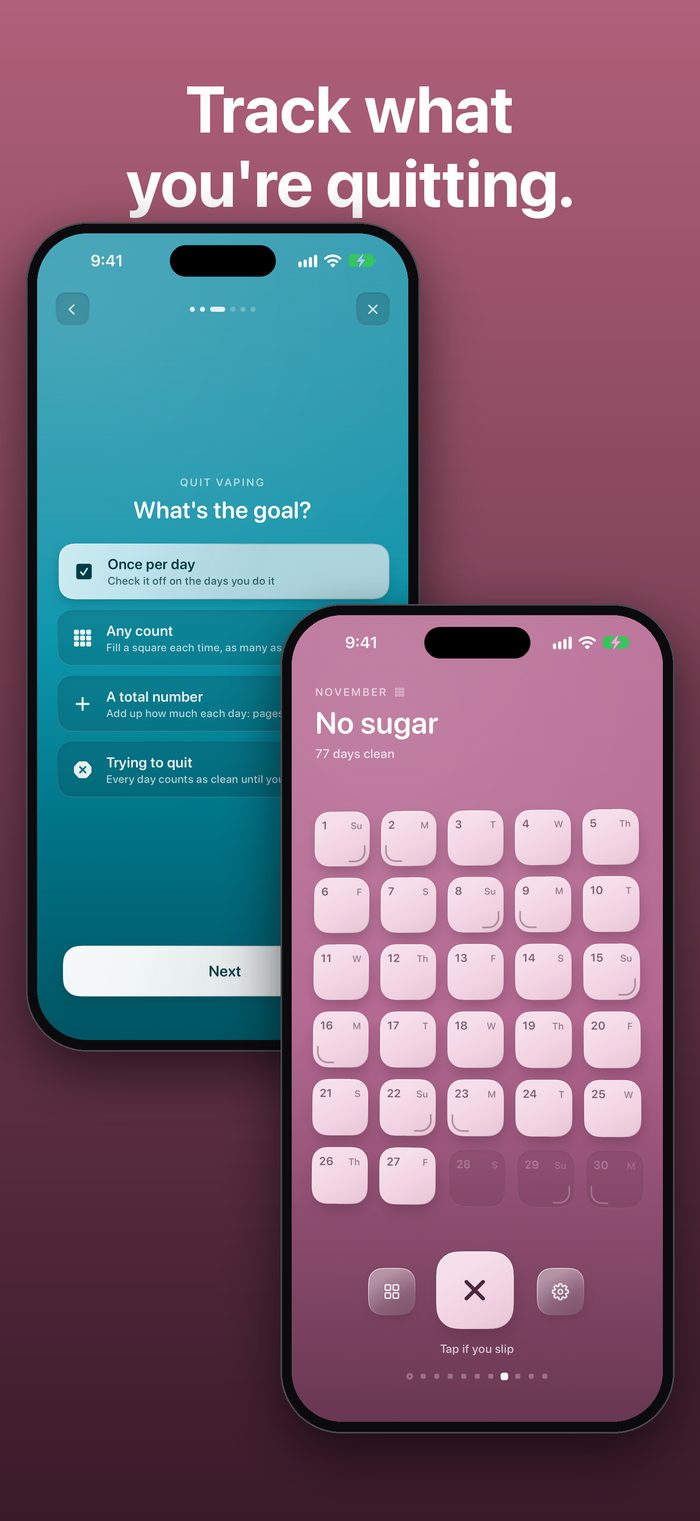
- Tap + on home to make a new habit.
- For smoking, alcohol or junk food, pick Quit smoking, No alcohol or No junk food under Quit, then Create.
- For anything else, tap Make your own, name it (like "No sugar"), and for the goal pick Trying to quit. Pick a color and tap Create.
- Logging a slip. Tap the button under the month ("Tap if you slip") or tap the day it happened. Tap again to take it back. The count of days clean starts again the next day.
- The record stays. Pinch in on the month for the year: clean days, the share of days clean and your longest clean run. A slip doesn't erase any of it.
- Milestones. 7, 14, 21 and 30 days clean each get a celebration, then every 50, and so does a whole month clean.
- No accidents. Quit habits don't send reminders, and widgets, the Apple Watch and Siri never log a slip. They just show your count.
Replacing the habit with a new one? Track that too, like a walk after dinner, next to the quit habit. Daytiles is free for up to three habits, and Pro makes room for as many as you like.
Sources
Updated November 3, 2026. Daytiles is made by Jason, one person. Tell me if something here is wrong.