 Daytiles
Missed a day? How to get back on track
One missed day feels like a bigger deal than it is. The research says a single miss barely matters. What matters is the next day. Here's how to get back to it without starting over in your head.
The short version
- One missed day doesn't undo a habit. A study found it made no real difference.
- The risk is the second day. A popular rule is "never miss twice."
- Come back with the smallest version, not a make-up session.
- Plan rest days ahead so they don't count as misses.
Daytiles keeps track of it for you, free on iPhone, iPad and Apple Watch. Get it on the App Store.
What one missed day does
Almost nothing. In Phillippa Lally's study at UCL of people forming new daily habits, missing a single day didn't meaningfully slow the habit down. People who missed a day and carried on got there about as well as people who didn't.
The real damage from a miss is in how you react to it. "I blew it" turns one day off into a week off, and a week off into quitting. That thought does far more harm than the day itself.
So the first step is to treat a miss as a fact, not a verdict. You missed Tuesday. Wednesday is still open.
Never miss twice
"Never miss twice" is a popular rule of thumb, made well known by James Clear's Atomic Habits. It isn't a research finding, but it fits what the research says: one miss is harmless, and the danger is a run of them. Two misses in a row starts to feel like a new normal.
To make the rule easy to keep, decide now what the smallest version of your habit is:
- Can't do a workout? Do five minutes, or one set.
- No time to read? Read one page.
- Skipped meditating? Sit for one minute before bed.
- Missed a walk? Walk around the block.
The tiny version keeps the habit's slot in your day. That's the part you're really building.
Don't make it up, just restart
It's tempting to do double the next day to make up for it. That usually backfires: a double workout leaves you sore and dreading the next one, and two hours of catch-up reading makes reading feel like homework. Do the normal amount, or less, and move on.
If you've been away for longer, a week or a month, restart smaller than where you left off. Think about what got in the way:
- Your routine changed? Find a new cue. If you used to stretch after your commute and now you work from home, tie it to something else. See how to build a habit.
- It was too big? Cut the goal in half. You can raise it again once it's steady.
- You forgot? Put it in sight, or set a reminder for just after your cue.
- You were sick or travelling? That's not failure. Pick it back up when you can.
Plan rest days
Some habits shouldn't be every day. Hard exercise needs recovery days. Some people want weekends free. If you plan those days ahead, they aren't misses, and you don't feel bad about them.
- Pick a weekly goal. "Four days a week" is easier to keep than "every day" and still builds the habit. How to stay consistent goes into this.
- Mark days off in advance. A holiday or a busy week you can see coming is a planned break, not a lapse.
- Be honest about which is which. A rest day you planned is fine. A "rest day" decided at 9 PM because you didn't feel like it is a miss, and that's fine too. Just do it tomorrow.
When it keeps happening
If you're missing more days than you hit, the plan is the problem, not you. Make it smaller, move it to a time of day that's calmer, or change how often you ask yourself to do it. For exercise in particular, going to the gym consistently and making exercise a habit have more.
Watch for all-or-nothing rules you've set without noticing, like "if I can't do the full hour, there's no point." Those rules turn every busy day into a miss. A habit that bends a little on hard days lasts much longer than one that only works on good ones.
And if what you're dealing with is a slip with a quit habit, like smoking or drinking, that's covered in how to break a bad habit and the guides for quitting smoking and drinking less.
Set it up in Daytiles
Daytiles is built so that planned time off doesn't count against you, and coming back gets noticed.
- Skip a day: touch and hold today's button under the month. For a past day, touch and hold the empty day and choose Skip this day. For a habit you add up, the keypad has Skip day.
- Pause for a while: in Settings, choose Pause, with no end or with a last day off. Habits pick up again the day after.
- Give it days off: in the habit's settings (the gear on its page), pick a schedule like set days or some days a week.
Here's how each kind of day counts:
- Skipped, paused and off-schedule days don't break a streak. Only a scheduled day left blank does.
- Paused days are fully off. They don't count against your streak, your weekly goal or your year, and no reminders come.
- Weekly goals free up the rest of the week. On a habit set to some days a week, once you've met the week's goal the remaining days are free.
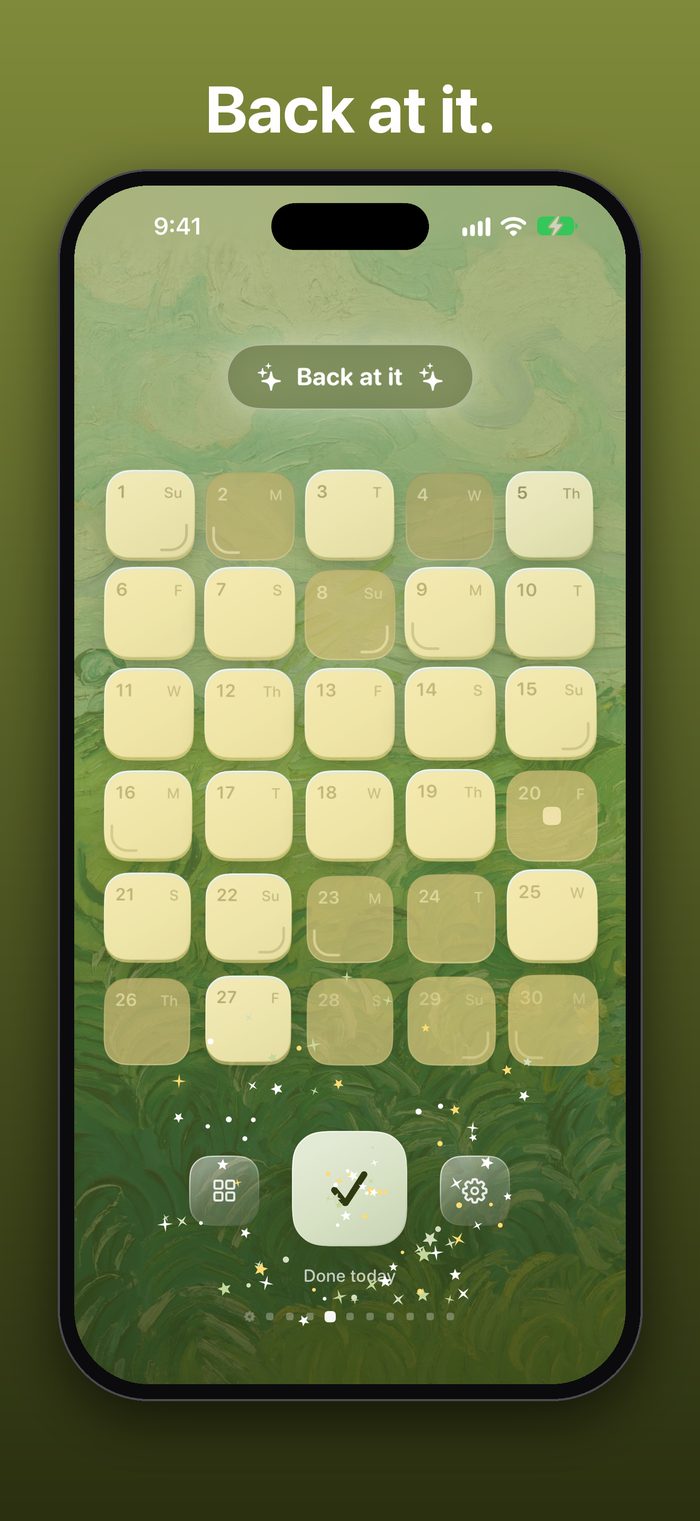
- Coming back is celebrated. Check off a habit after a few missed days and it says "Back at it". For a habit you do a few days a week, it takes a week away.
- Your record stays. A miss resets the current run, but the year keeps every day you did and your best run.
Skipping, pausing and schedules are all free. Daytiles is free for up to three habits, and Pro makes room for as many as you like.
Sources
Updated November 3, 2026. Daytiles is made by Jason, one person. Tell me if something here is wrong.