 Daytiles
How to build a habit
A habit is something you do without having to decide to. You get there by doing a small thing the same way, in the same place, over and over. Here's how to set that up so it actually happens.
The short version
- Start with a version so small you can't say no to it.
- Tie it to something you already do: "After I pour my coffee, I will..."
- Make it obvious and easy, and make skipping it a little harder.
- Track it, and expect it to take about two months, not three weeks.
Daytiles keeps track of it for you, free on iPhone, iPad and Apple Watch. Get it on the App Store.
Start smaller than feels useful
The most common mistake is starting with the goal instead of the habit. "Work out an hour a day" is a goal. A habit is the thing you'll still do on a tired Tuesday. So shrink it until it's almost silly:
- One push-up, or putting on your running shoes.
- One page of a book.
- Two minutes of sitting quietly.
- One line in a journal.
The point at first is to show up, not to get results. Once doing it is automatic, making it bigger is easy. Making a big thing automatic is the hard part, so don't start there.
Pick one habit to start. Two or three at most. Each new habit takes attention while it's forming, and spreading that thin is how all of them fade together.
Tie it to something you already do
New habits need a cue, something that reminds you to do them. The best cue is a thing you already do every day without thinking: waking up, making coffee, brushing your teeth, sitting down at your desk, getting into bed.
Write it as one sentence:
- "After I pour my morning coffee, I will take my vitamins."
- "After I brush my teeth at night, I will read one page."
- "After I park at work, I will sit for two minutes and breathe."
Psychologists call a plan like this an implementation intention. Peter Gollwitzer's research on "if this happens, then I'll do that" plans found that people who make them follow through more often than people who only set a goal. James Clear calls the same idea habit stacking in Atomic Habits, and BJ Fogg's Tiny Habits uses the "After I..." wording too.
Be exact about the cue. "In the morning" is vague. "After I put the kettle on" is a moment you'll notice.
Make it obvious and easy
Every bit of effort before you start is a chance to skip it. Clear those out of the way:
- Put it in sight. Vitamins next to the coffee maker. The book on your pillow. The water bottle on your desk.
- Get things ready the night before. Gym clothes laid out, a yoga mat already on the floor.
- Cut the steps. If a habit takes five things to start, find a way to make it two.
- Make the opposite harder. If you want to read more at night, charge your phone in another room.
This matters more than motivation. Motivation goes up and down every day. A setup that makes the habit the easy choice works on your bad days too.
Do it in the same place, at the same time
Habits form when the same situation keeps leading to the same action. Doing it after the same cue, in the same spot, is what turns a choice into a reflex. Meditating in the same chair after breakfast every day builds faster than meditating whenever there's a spare moment.
When life changes the setting, like travel or a new job, expect the habit to wobble. Pick a new cue for the new place and keep going.
Track it
Checking off each day does a few things. It's a small reward right after you do it, which is the part of a habit loop people forget. It shows you a run of days you'll want to keep going. And it gives you honest data: you'll see if you're actually doing it four days a week or one.
Keep tracking simple. If logging takes longer than the habit, you'll stop logging. A tap or a check mark is enough. See how to track habits on iPhone for the options.
Give it time, and don't panic over a miss
The "21 days" idea isn't backed by research. In a study at UCL, people took a median of 66 days for a daily habit to become automatic, and some took much longer. More in how long it takes to form a habit.
The same study found that missing one day didn't hurt. What hurts is letting one miss turn into a week. If you miss, do the tiny version the next day. There's more in missed a day? and how to stay consistent.
Not sure where to start? Good habits to track every day has a list, with a guide for each, like drinking water, meditating or reading. If what you want is to stop something, see how to break a bad habit.
Set it up in Daytiles
Daytiles gives each habit its own page with a month of tiles. Every day you do it, a tile lights up. You can start from a ready-made habit or make your own.
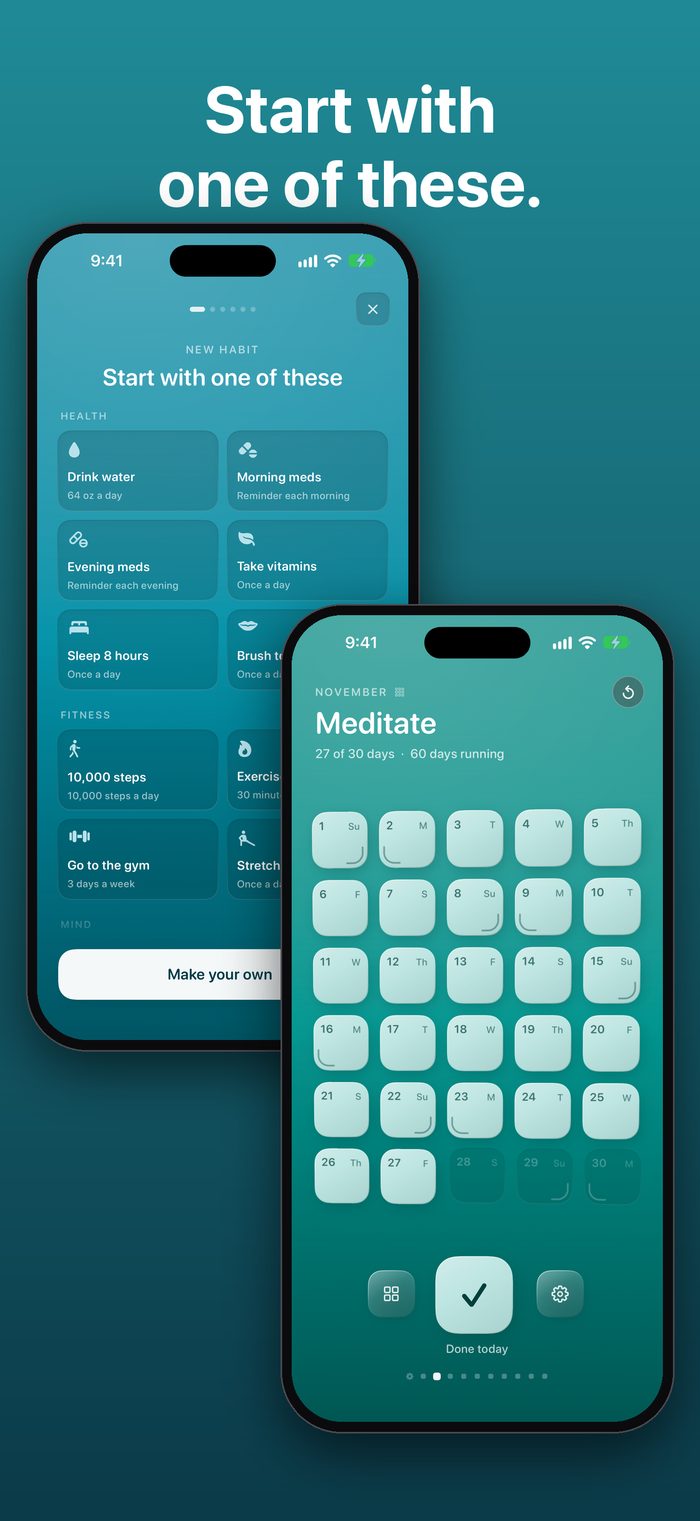
- Tap + on home to make a new habit.
- Pick one under Health, Fitness, Mind or Quit, look it over and tap Create. Or tap Make your own.
- Making your own asks one thing at a time: what you want to do, what the goal is, which days, a color, and whether you want a reminder. Then tap Create.
For the goal, pick Once per day for something you either did or didn't, like taking vitamins. Pick A total number for something you add up, like pages or minutes. Start the goal small. You can raise it later in the habit's settings (the gear on its page).
- Pick the days that fit. A once-per-day habit can be every day, weekdays, some days a week (like three), set days, or every few days. Days off the schedule never count against you.
- Check it off fast. Tap the big button under the month to check off today. For a total, tap + to add one step. You can also do it from the Home Screen widget, the Lock Screen, Apple Watch, Control Center or Siri ("Check off Read in Daytiles").
- A nudge if you need it. Turn on the morning or evening reminder. A habit you've already done drops out of it, so a day you've done everything stays quiet. Pro lets a habit have its own reminder time, set to just after your cue.
- See it add up. Runs of 7, 14, 21 and 30 days get a celebration, and pinching in on the month shows the whole year.
Daytiles is free for up to three habits, which is the right number to start with anyway. Pro makes room for as many as you like.
Sources
Updated November 3, 2026. Daytiles is made by Jason, one person. Tell me if something here is wrong.