 Daytiles
How to build habits with ADHD
Most habit advice assumes you'll remember to do the thing. With ADHD, remembering is often the hard part. These are practical ways to lean less on memory and more on your surroundings.
The short version
- Don't rely on remembering. Put reminders outside your head: alarms, notes, things in plain sight.
- Make each habit smaller and cut out steps, so starting takes almost nothing.
- Attach new habits to things you already do every day.
- Missed days will happen. Plan for them, and start again the next day.
Daytiles keeps track of it for you, free on iPhone, iPad and Apple Watch. Get it on the App Store.
This is practical, everyday advice, not medical advice. If you have ADHD or think you might, work with your doctor or therapist, especially on anything to do with medication. Don't start, stop or change a medicine or its timing without them.
Stop relying on memory
A lot of habit advice comes down to "remember to do it". If remembering is the part that keeps failing, more effort won't fix it. Move the remembering out of your head and into the world around you.
- Reminders at the moment you need them. An alarm at 8:00 for something you need to do at 8:00, not a note to "remember later".
- Reminders that keep coming until it's done. One alert that's easy to dismiss and forget doesn't help much. One that comes back, or stops only when you mark it done, does.
- Notes where the task happens. A sticky note on the door for keys, on the mirror for brushing, on the fridge for meds.
Keep it in sight
Out of sight really can be out of mind. Use that instead of fighting it.
- Leave your running shoes by the door, not in the closet.
- Keep the book you're reading on your pillow, so you see it at bedtime.
- Put a water bottle on your desk where you'll knock into it.
- Keep your pill organizer where you'll see it every morning, out of reach of children.
Clear boxes, open shelves and hooks often work better than drawers and cupboards, for the same reason.
Make it smaller
Starting is often the hardest part. The bigger a habit feels, the easier it is to put off. Shrink it until starting feels like nothing.
- "Go for a run" becomes "put on running shoes and step outside".
- "Clean the kitchen" becomes "load five things into the dishwasher".
- "Journal" becomes "write one sentence".
If you do more once you've started, great. If you don't, you still kept the habit going, and that's the part that builds over time.
Cut out steps
Every extra step is a place to get distracted. Count the steps between you and the habit, and remove as many as you can.
- Lay out tomorrow's clothes and gym bag the night before.
- Pre-fill a weekly pill organizer so each morning is one box, not four bottles.
- Keep a habit's tools in one place, like a basket with your journal and pen.
- Track habits somewhere you can check them off in one tap, without opening an app and finding a screen.
Tie it to things you already do
Routines you already have, like making coffee, brushing your teeth or plugging in your phone, are anchors. Attach the new habit right after one: "After I pour my coffee, I take my meds." The anchor does the remembering for you.
Pick anchors that really happen every day. If your mornings change a lot, an evening anchor may be more reliable.
Get some company
Body doubling means doing a task with someone else around, in person or on a video call. They don't need to help, or even do the same thing. Some people with ADHD find it easier to start and keep going when someone else is there. Some use online body doubling sessions, or a friend on a call while both of you get through chores.
Telling someone what you're working on can help too, as long as it feels like support, not pressure.
Make it interesting
Boredom is a real obstacle. Change things up before a habit gets stale: a new route for your walk, a new podcast for the dishes, a different place to read. Seeing progress also helps. A row of filled-in days is a small reward you can look at.
Forgive missed days
You will miss days. Everyone does. The research on habits backs this up: in a 2009 study at University College London, Phillippa Lally and colleagues found it took a median of 66 days for a daily habit to become automatic, with a wide range, from 18 to 254 days, and missing a single day didn't hurt the overall progress.
What hurts is deciding that a missed day means you've failed and giving up. Plan for misses instead: have a smaller version for bad days, allow rest days on purpose, and take a break when life gets in the way. Then start again the next day.
"I have diagnosed ADHD and OCD," says Jason, who makes Daytiles. He built Daytiles for himself and uses it every day.
Set it up in Daytiles
Start with just a few habits. Daytiles has ready-made ones you can make in a couple of taps, and you can check them off without opening the app.

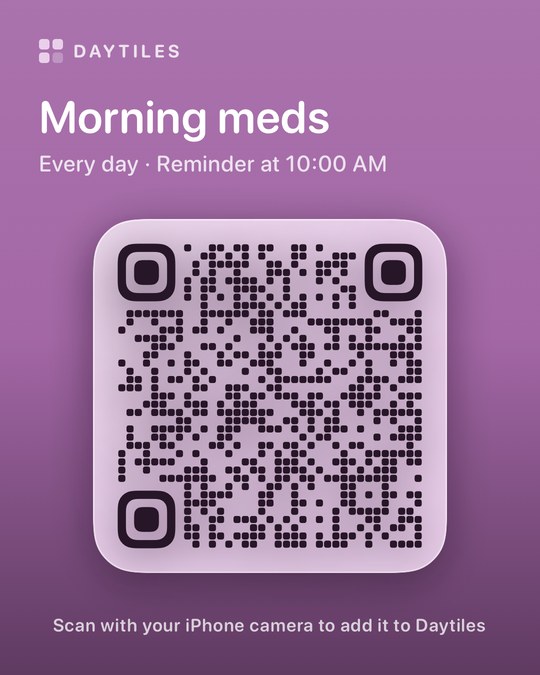
- Tap + on home to make a new habit.
- Pick a ready-made habit, like Morning meds, Drink water or Brush teeth, or tap Make your own.
- Under Remind me, tap Yes and turn on Morning, Evening or both. Set a time for just this habit Pro.
- Tap Create. Repeat for two or three habits at most to start.
- Reminders that go quiet once you're done. A habit drops out of today's reminders as soon as it's checked off, so on a day you've done everything, nothing comes. A reminder for one habit has Done and Remind me in an hour buttons: touch and hold the reminder, or pull it down, to see them.
- More nudges. Add up to two more reminder times for a habit you tend to miss Pro.
- Check off without opening the app. Add the "Today" widget to your Home Screen, or Daytiles widgets to your Lock Screen, and tap a habit there to check it off. Fewer steps, fewer chances to get pulled into something else.
- Skip a day. Touch and hold today's button to skip today. Skipped days don't break your streak.
- Pause. Going through a rough patch, traveling or ill? In Settings, tap Pause, with no end or an end date. Paused days don't count against you, and no reminders come.
- Fewer days. A habit doesn't have to be every day. In its settings, pick weekdays, a few days a week or set days. Days off the schedule never count against you.
Daytiles is free for up to three habits, which is a good number to start with. Pro makes room for as many as you like.
Sources
Updated November 3, 2026. Daytiles is made by Jason, one person. Tell me if something here is wrong.