 Daytiles
How to learn a language every day
Languages are learned a little at a time, over months. Fifteen minutes a day, done every day, beats an hour now and then. Here's how to spend those minutes.
The short version
- Review words with spaced repetition, a little every day.
- Listen a lot, to things you mostly understand.
- Start speaking early, even badly. Out loud counts.
- Set a small daily minimum, like 15 minutes, and keep it on busy days.
Daytiles keeps track of it for you, free on iPhone, iPad and Apple Watch. Get it on the App Store.
Review words with spaced repetition
You can't speak without words, and words are forgotten fast unless you see them again. The trick is to see each one again just as you're about to forget it. That's spaced repetition.
It's backed by a lot of research. A 2013 review of learning techniques by Dunlosky and colleagues, published by the Association for Psychological Science, rated two methods as the most useful: spreading practice out over time, and testing yourself. Rereading and highlighting rated low. Spaced repetition does both of the useful ones.
- Use flashcards that test you. See the word, try to remember the meaning, then check. The effort of remembering is what makes it stick, so don't flip the card straight away.
- Let an app do the spacing. Flashcard apps with spaced repetition show the words you know less often and the ones you miss more often. Paper cards in a box sorted by how well you know them work too.
- Review every day. Ten minutes daily keeps the pile small. Skip a week and it turns into a mountain.
- Learn words you'll use. Start with the most common words and phrases, and the ones for your own life: your job, your family, your food.
Listen a lot
Listening is how you get used to the sound and speed of real speech. It's also the easiest part to fit into a day, because you can do it while you walk, cook or drive.
- Pick things you mostly understand. If you only catch one word in ten, it's noise. Learner podcasts, slow news and children's shows are good starts.
- Listen to the same thing more than once. The second time you'll catch more.
- Watch shows you like with subtitles in the language you're learning, once you're ready for it.
Start speaking early
Most learners wait until they feel ready to speak, and that day never comes. Speaking is a skill of its own, and it only improves when you do it. You'll make mistakes. Everyone does, and the people you talk to will mostly be pleased you tried.
- Talk to yourself. Describe what you're doing as you make dinner. Out loud counts.
- Shadow. Play a short clip, pause, and repeat it, copying the rhythm and sounds.
- Find a partner. A tutor online, a language exchange, or a local conversation group. Even a short chat each week gets you used to speaking with a real person.
- Write a few lines. Three sentences about your day, in the language. It makes you find the words you're missing.
Set a small daily minimum
A language takes months and years, so the habit matters more than any single session. Pick a minimum small enough to do on your worst day, like 15 minutes, and make it non-negotiable. On good days, do more.
A 15-minute day might look like this:
- Flashcard review, 5 to 10 minutes.
- Listening or reading, 5 minutes.
- Say or write three sentences, 1 to 2 minutes.
Tie it to something you already do every day. "With my morning coffee, I do my cards." "On the walk to work, I listen." It's easier to remember when it rides along with another part of the day.
Expect it to feel slow. Progress in a language is hard to see week to week, and easy to see over months. Keeping a record of your days helps on the weeks when it feels like nothing's happening.
Set it up in Daytiles
Track minutes of practice with a goal of 15 a day. Tap to add 5 minutes after each piece (cards, listening, speaking) and the day fills up.
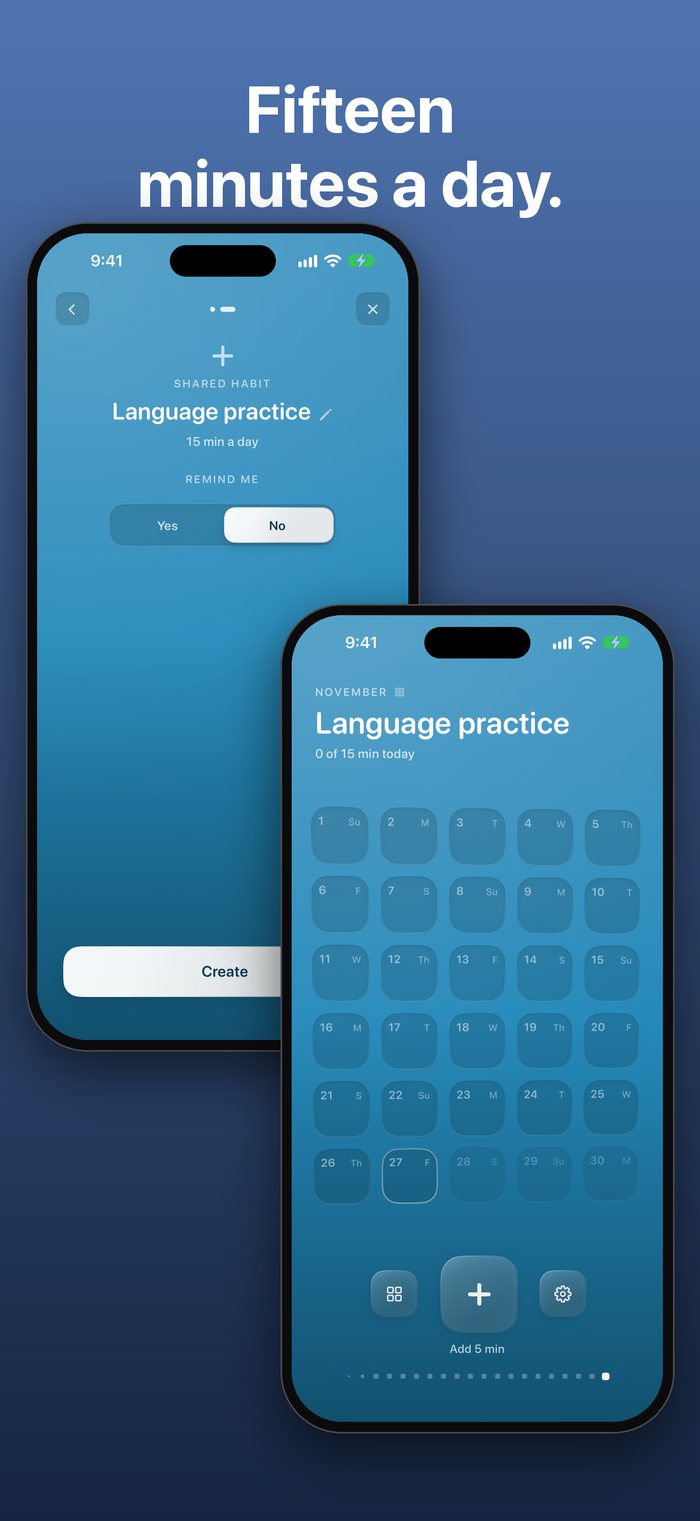
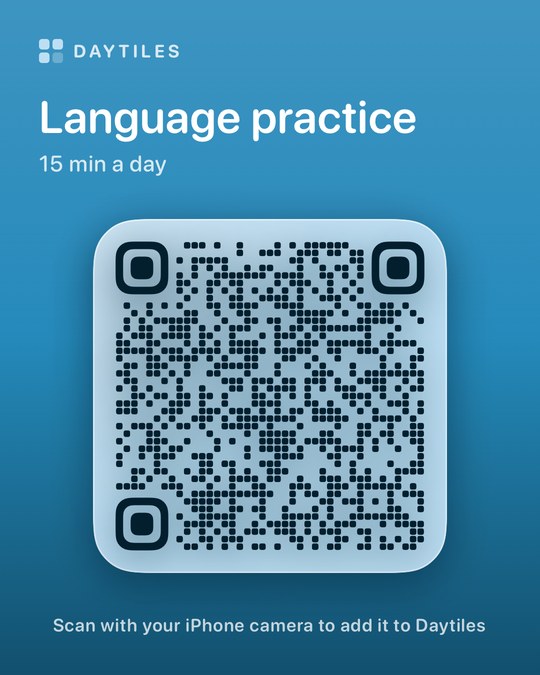
The quickest way is the code on this page. Scan it with your iPhone camera, or tap it on your iPhone, and Daytiles opens with the habit set up, ready to add.
- Tap + on home to make a new habit, then tap Make your own.
- For "What do you want to do?", type Language practice.
- For "What's the goal?", choose A total number.
- For "What are you adding up?", tap min.
- Pick a color you like.
- When it asks about reminders, tap No. You can add one later in the habit's settings.
- Tap Create. Then tap the gear on its page and set DAILY GOAL to 15 and EACH TAP to 5.
Each day's tile fills as you add minutes and is done at 15. Tap + to add 5 minutes, or touch and hold it for a keypad to type a different amount, like 30 after a lesson with a tutor.
- Add from anywhere. Tap the habit in the Today widget to add 5 minutes without opening the app. It shows on your Apple Watch too, with iCloud sync on. Or ask Siri: "Add to Language practice in Daytiles."
- A timer Pro. Turn TIMER on in the habit's settings and the + becomes start and stop, with a Live Activity counting down on your Lock Screen.
- A nudge at your practice time Pro. Without Pro, your morning or evening reminder from Settings can include it. Nothing comes on a day you've already done your 15.
- Off days. Touch and hold + and tap Skip day on the keypad. Skipped days don't break your streak.
- See the months add up. Pinch in on the month to see your year: days done, your current run and your best.
Daytiles is free for up to three habits, and Pro makes room for as many as you like.
Sources
Updated November 3, 2026. Daytiles is made by Jason, one person. Tell me if something here is wrong.