 Daytiles
How to practice guitar every day
Twenty minutes a day will get you further than two hours on Sunday. Here's how long to practice, what to do with the time, and how to make picking up the guitar the easy choice.
The short version
- Short and daily beats long and weekly. Twenty minutes is plenty to start.
- Go in with a plan: warm up, one thing to learn, then play something you enjoy.
- Leave the guitar out on a stand, not in its case.
- On a busy day, five minutes still counts.
Daytiles keeps track of it for you, free on iPhone, iPad and Apple Watch. Get it on the App Store.
How long to practice
For most people learning guitar, 15 to 30 minutes a day is a good amount. It's long enough to get something done and short enough to fit into a normal day, so you'll actually do it.
Daily beats weekly for a few reasons:
- Spreading practice out works better. A large 2013 review of learning research by Dunlosky and colleagues rated spaced practice, spreading sessions out over time instead of cramming them together, as one of the two most useful ways to learn. It was studied mostly with school learning, but the idea carries over: little and often.
- Your fingers toughen up. Fingertips get tougher with steady playing, so the strings hurt less, sooner.
- You remember where you were. Coming back the next day, yesterday's chord change is still fresh. Coming back a week later, you spend the first half hour relearning it.
If you have more time, take a break every 20 or 30 minutes. Shake out your hands and come back. Tired hands practice mistakes.
If your hand, wrist or arm hurts while you play, beyond sore fingertips at the start, stop and rest. If it keeps happening, see a doctor or a physiotherapist, and ask a teacher to check your posture.
Have a plan for each session
The most common way to waste practice is to pick up the guitar and noodle through the three songs you already know. That's fun, and it has its place, but it won't move you forward. A simple shape for 20 minutes:
- Warm up, 3 minutes. A few slow chord changes or a simple scale, to get your fingers moving.
- One thing to learn, 12 minutes. One new chord, one tricky change, one strumming pattern or one section of a song. Just one.
- Play, 5 minutes. Something you enjoy, using what you know. This is why you're doing it.
Work slowly on the new thing. Play it slowly enough to get it right, a few times in a row, before speeding up. A metronome app helps: start slow and move it up a few beats per minute only once it's clean.
At the end, write down what to work on tomorrow. A line in a notebook kept in the guitar case or on your phone is enough. Then the next session starts without deciding anything.
Leave the guitar out
If your guitar lives in its case under the bed, every session starts with getting it out, tuning it, and finding a pick. That's enough to put you off on a tired evening. Make it easy instead:
- Put it on a stand or a wall hanger where you'll walk past it, next to the sofa or the desk.
- Keep a tuner, picks and your notebook right next to it.
- Clip-on tuners stay on the headstock, so tuning takes seconds.
Then pick a time and a cue. "After dinner, before the TV goes on, I play for 20 minutes." Plans that say exactly when and where you'll do something are followed through more often than good intentions. A 2006 review by Gollwitzer and Sheeran of 94 tests found a medium-to-large effect.
On busy days, do five minutes
Some days, 20 minutes won't happen. Pick up the guitar anyway, and play one chord change or one song for five minutes. It keeps your fingers going, and it keeps the habit of picking it up every day, which matters more than any single session.
And if you miss a day, just play the next one. One missed day doesn't undo anything. In a UCL study by Lally and colleagues, one missed day didn't affect how a habit formed.
Set it up in Daytiles
Track your minutes of practice with a goal of 20 a day. Tap to add 5 minutes at a time, or turn on a timer and let it count for you.
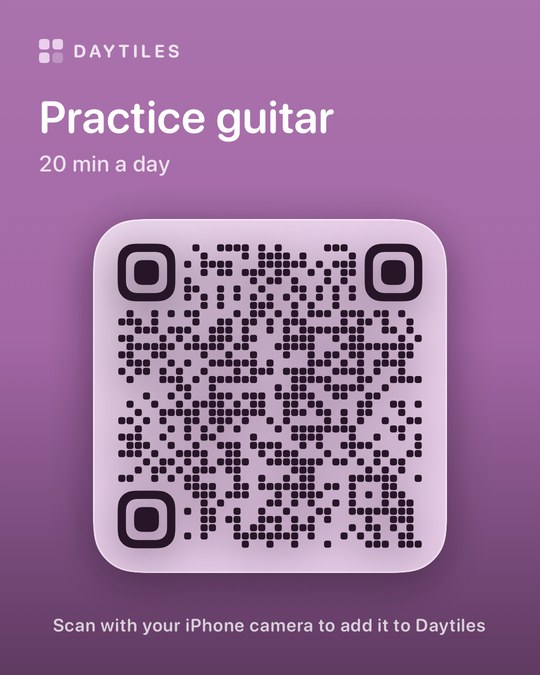
The quickest way is the code on this page. Scan it with your iPhone camera, or tap it on your iPhone, and Daytiles opens with the habit set up, ready to add.
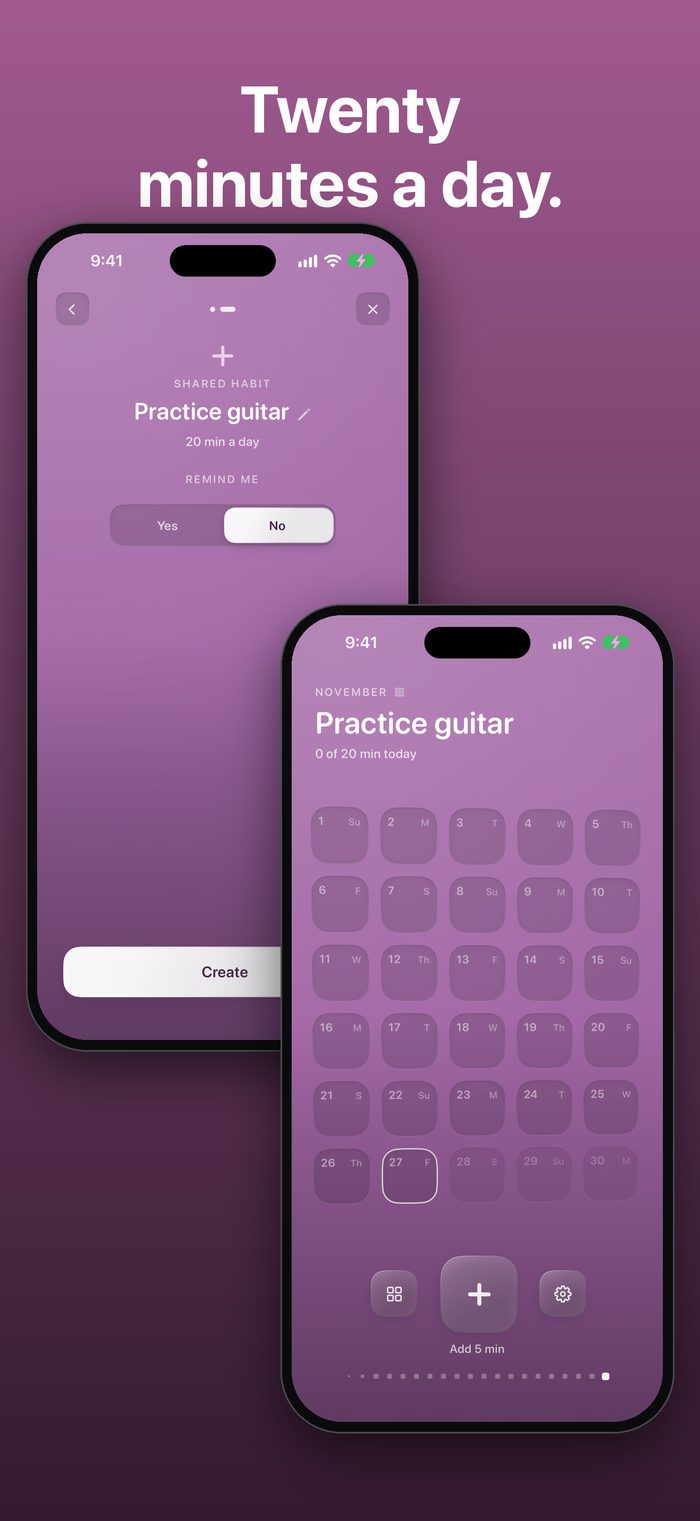
- Tap + on home to make a new habit, then tap Make your own.
- For "What do you want to do?", type Practice guitar.
- For "What's the goal?", choose A total number.
- For "What are you adding up?", tap min.
- Pick a color you like.
- When it asks about reminders, tap No. You can add one later in the habit's settings.
- Tap Create. Then tap the gear on its page and set DAILY GOAL to 20 and EACH TAP to 5.
Each day's tile fills as you add minutes and is done at 20. Tap + to add 5 minutes, or touch and hold it for a keypad to type how long you played.
- Use a timer Pro. Tap the gear and turn TIMER on. The + becomes start and stop, and the page shows time done and time to go. A Live Activity counts down on your Lock Screen and in the Dynamic Island, so you can keep both hands on the guitar. Stopping logs the minutes, and a notification tells you when you've reached 20.
- A five-minute day still fills a quarter of the tile, so you can see you showed up. Lower DAILY GOAL any time if 20 is too much right now.
- A nudge at your practice time Pro. Without Pro, your morning or evening reminder from Settings can include it. Nothing comes on a day you've already played.
- Away from the guitar? Touch and hold + and tap Skip day on the keypad. Skipped days don't break your streak. Going on holiday without it? In Settings, tap Pause.
- Keep a note. Touch and hold a done day to keep a few words with it, like the song you learned or the tempo you hit Pro.
Pinch in on the month to see your year: days done, your current run and your best. Daytiles is free for up to three habits, and Pro makes room for as many as you like.
Sources
Updated November 3, 2026. Daytiles is made by Jason, one person. Tell me if something here is wrong.